
pawnbroking guide
Patek Philippe as Collateral: Why Complications Command Premium Loans
Why Patek Philippe complications such as perpetual calendars and minute repeaters attract serious interest from lenders, and where caution applies.
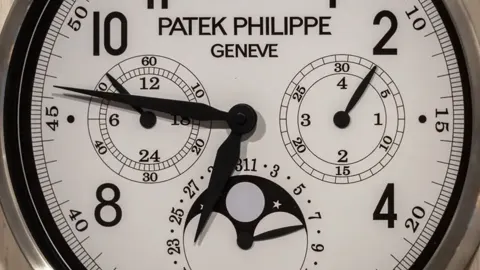
A Genevan name with unusual staying power
Patek Philippe occupies a particular place in the lender’s imagination. Founded in Geneva in 1839 and independently owned for generations, it has built a reputation for continuity that few luxury houses can match. Its watches appear regularly at the major auction houses, often at the very top of the results, and there is a well-established collector base that follows references closely. For a pawnbroker, that combination of recognition, scarcity and auction visibility makes a Patek one of the most dependable pieces of collateral available.
Yet ‘Patek’ is not a single category of risk. A simple gold Calatrava on a leather strap and a grand complication with a perpetual calendar and minute repeater are both unmistakably Patek Philippe, but they sit in different markets, attract different buyers and carry very different price stability. A thoughtful lender distinguishes between them carefully. This article looks at why complicated Pateks in particular tend to command stronger interest, and why the specialist knowledge needed to value them is part of the price of borrowing against one.
What a complication actually is
In watchmaking, a complication is any function beyond telling the hours, minutes and seconds. Patek Philippe has long been associated with several of the most demanding: the chronograph, which times intervals; the annual calendar, which needs correcting only once a year; the perpetual calendar, which accounts for months of different lengths and leap years; the minute repeater, which chimes the time on tiny gongs; and the tourbillon, which houses the escapement in a rotating cage. Each adds components, hours of hand finishing and specialist assembly.
The more complicated a watch, the fewer can be produced and the fewer people in the world are qualified to service it. That scarcity is a large part of the appeal. Complicated Pateks are typically made in limited numbers each year, which helps explain why the secondary market for them has historically been resilient. For a lender, a watch that is difficult to manufacture, difficult to replicate convincingly and eagerly sought by an international pool of collectors is precisely the kind of asset that holds its worth across the life of a loan.
Why lenders will stretch further for the right piece
Loan amounts depend on the lender’s estimate of realistic resale value and on how confident it is of achieving that figure. With a complicated Patek from a desirable reference in excellent, original condition, both elements can be strong. The watch is likely to find a buyer through auction or private sale, and the depth of collector interest reduces the risk that the lender would be forced to sell at a steep discount. That confidence can translate into a larger advance than an equivalent sum of money spread across less prestigious pieces.
There is also the question of absolute value. Because a single complicated watch can be worth a very considerable sum, one pledge may be enough to meet a borrower’s needs, which is simpler for everyone than pledging several items. Specialist high-end lenders are set up for exactly this kind of transaction, with secure storage, appropriate insurance and staff who understand the market. Still, the lender will always keep a margin between the loan and the watch’s value, and the more unusual the piece, the more carefully that margin is judged.
Where caution creeps in
Complication is not automatically a guarantee of liquidity. Some highly complicated references appeal to a very small number of collectors, and a watch that might achieve an impressive price at the right auction could take a long time to sell privately. Lenders are wary of pieces whose value depends on finding one particular buyer. They may also be more conservative with precious-metal dress complications that have fallen out of fashion compared with the sports models that have dominated recent collector attention.
Servicing adds another layer. A minute repeater or perpetual calendar that is not functioning correctly may need attention from the manufacturer or a highly specialised watchmaker, which can be costly and slow. A lender will test every function it can, and if a complication does not work as intended, the offer will reflect the likely repair bill and the uncertainty involved. Owners should be candid about any known faults, since discovering them later rarely improves the conversation.
Papers, the Seal and the archive extract
Documentation carries real weight with Patek Philippe. A modern watch will normally come with a certificate of origin and a box, and since 2009 the company has applied its own Patek Philippe Seal, a quality standard covering the whole watch rather than just the movement. For older pieces, the manufacture can issue an Extract from the Archives confirming the original specification and date of production. These documents help a lender confirm that the watch is what it appears to be and that key parts are original.
That said, documents must be matched to the watch in hand. Lenders compare case and movement numbers against the paperwork and look for signs that parts have been exchanged over the years. A service carried out by the manufacture may have replaced some components, which is not necessarily a problem but should be recorded. As with any high-value pledge, identification and anti-money laundering checks are routine, and a clear chain of ownership makes the whole process faster and more comfortable.
Thinking beyond the headline figure
A large advance against a prestigious watch can be tempting, but the size of a loan is only one part of the arrangement. The interest rate, any fees, the length of the agreement and the terms on which it can be extended all affect the total cost. Pawn loans are regulated under the Consumer Credit Act 1974, with a minimum redemption period of six months and the right to redeem at any time before sale. Reading the agreement in full and comparing more than one lender is sensible, particularly when the sums involved are substantial.
It is also worth being honest about intentions. For collectors who plan to keep a Patek for life, a well-structured short-term loan can bridge a gap without a permanent sacrifice. For those who suspect they may not want the watch back, a sale may be cleaner and less costly. Owners weighing that choice can ask EncoreLuxe for a private valuation of a Patek Philippe, which gives a clear outright figure to set alongside any loan offer.